
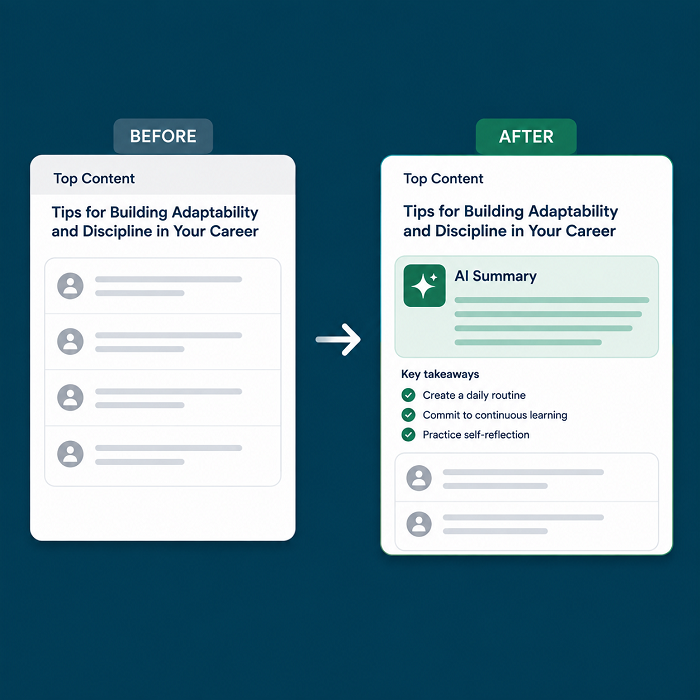
Based on Wayback Machine snapshots and organic traffic trends collected through July 2026.
For years, LinkedIn Pulse was one of Google’s biggest user-generated content success stories.
After Google’s Helpful Content Update, Pulse pages gained significant visibility, allowing many creators to rank for competitive search terms.
That momentum did not last.
Here’s a chart showing the decline in organic keywords for LinkedIn Pulse:
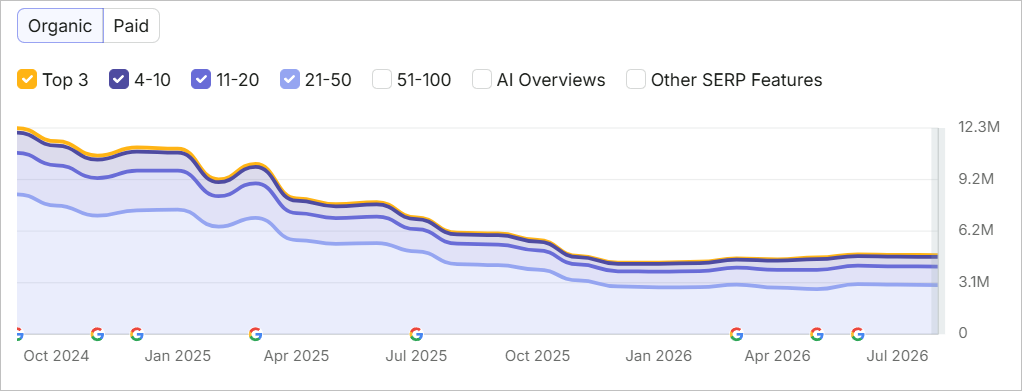
Since early 2025, LinkedIn’s organic traffic has steadily declined. At the same time, the company quietly launched a different SEO strategy that has received very little attention.
Instead of relying on thousands of user-written articles, LinkedIn appears to be investing in AI-generated collection pages that summarize discussions from its own community.
The evidence comes from Wayback Machine snapshots, metadata changes, and traffic trends.
A collection page that looked like every other aggregator
In October 2025, LinkedIn’s Top Content pages were extremely simple.
The page titled Tips for Building Adaptability and Discipline in Your Career contained little more than a list of LinkedIn posts.
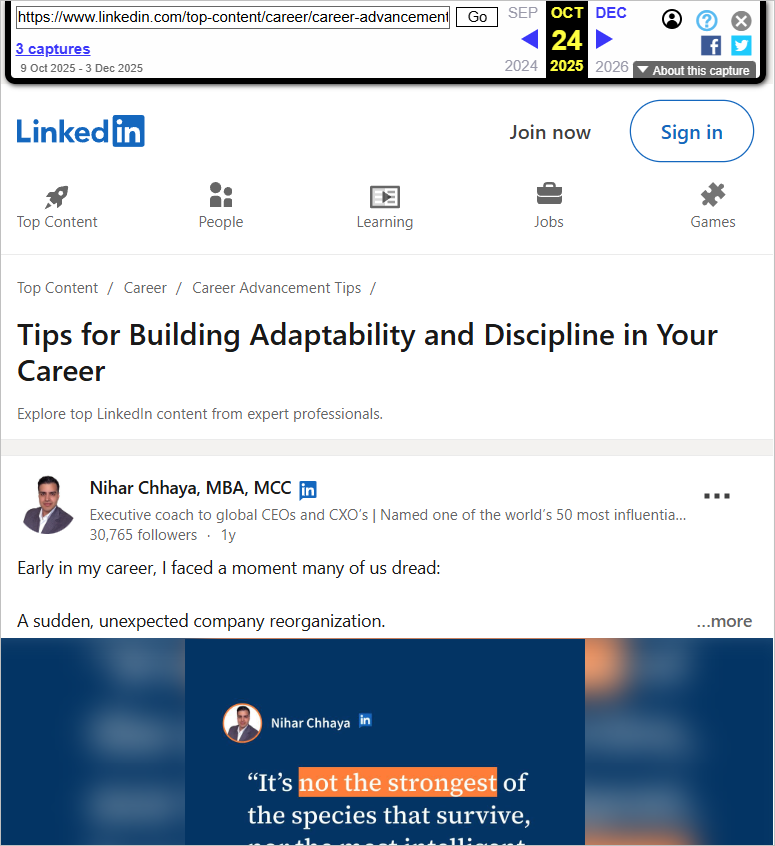
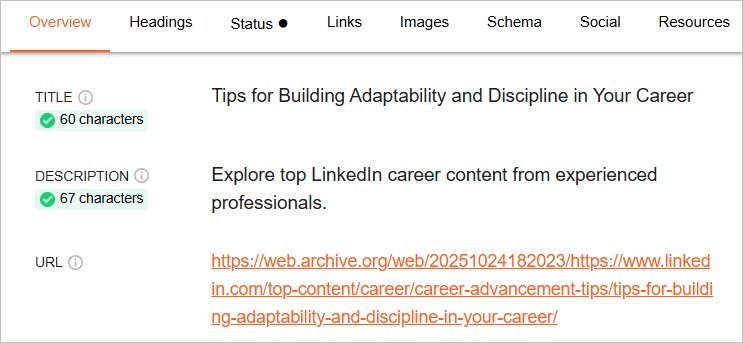
In fact, the metadata for these collection pages was also generic, with the same meta description being used across multiple pages.
Everything changed within six weeks
Wayback Machine snapshots show that the redesign happened between October 24, 2025 and December 3, 2025.
When the same page was archived in December, the experience looked completely different.
Instead of showing posts immediately, LinkedIn added an AI generated summary at the top of the page.
The summary explained the topic before users reached the community posts.
Rather than forcing visitors to scroll through multiple opinions, LinkedIn now fulfilled the search intent immediately.
Here’s what it looks like:
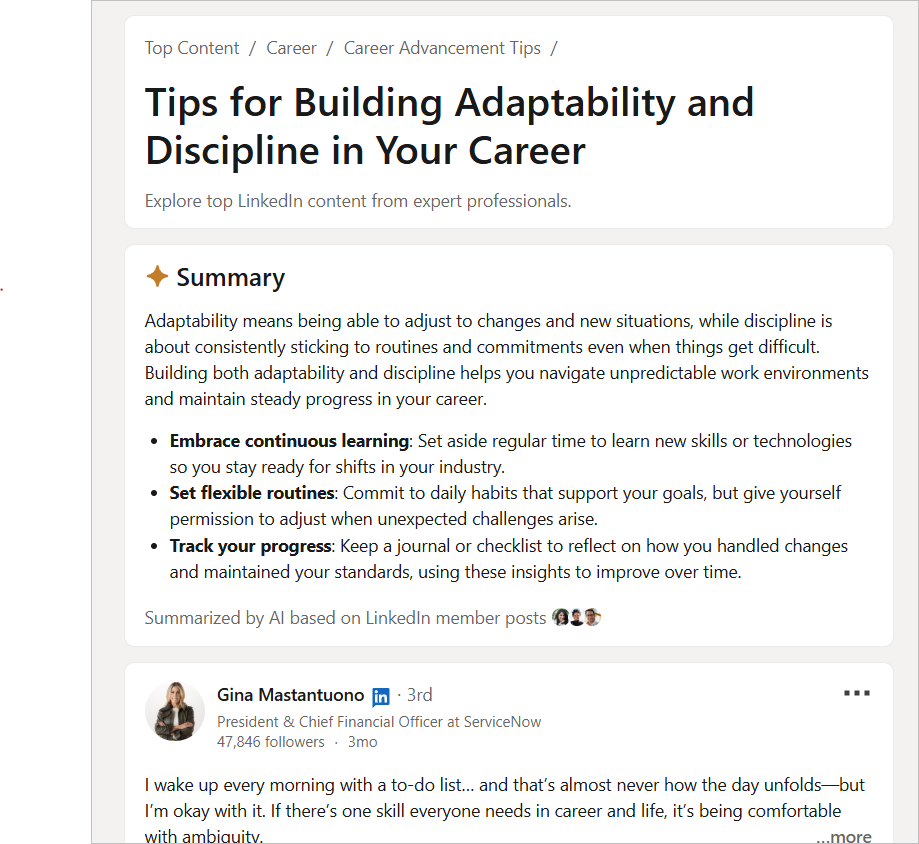
The summary also highlighted three key recommendations.
- Create a daily routine
- Commit to continuous learning
- Practice self-reflection
It tells users where the information came from while making it clear that the page is no longer just an archive of posts. It has become an AI-generated resource.
The metadata also became far more descriptive
The redesign did not stop with the page content. LinkedIn also replaced the generic page description.
Instead of using the same description across multiple pages, the new metadata reflected the actual topic.
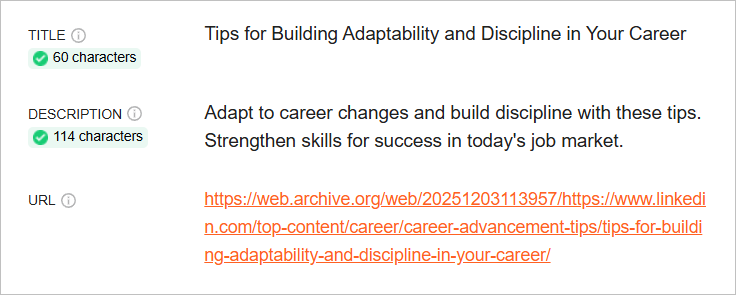
The updated description focused on adaptability, discipline, career changes, productivity, and sustainable habits.
In other words, the metadata was generated from the AI summary itself.
This creates several SEO advantages.
- Every page now has unique metadata.
- The description better matches user intent.
- Search engines receive stronger topical signals.
- Users can understand the page before clicking.
This is a significant improvement over the earlier template.
The timing becomes even more interesting
The redesign happened while LinkedIn was facing declining organic visibility.
Over the past two years, LinkedIn’s pulse subfolder’s organic traffic has fallen sharply.
Traffic peaked after Google’s Helpful Content Update, but the decline began in early 2025 and continued throughout the year.
By July 2026, estimated organic traffic had dropped substantially from its earlier peak.
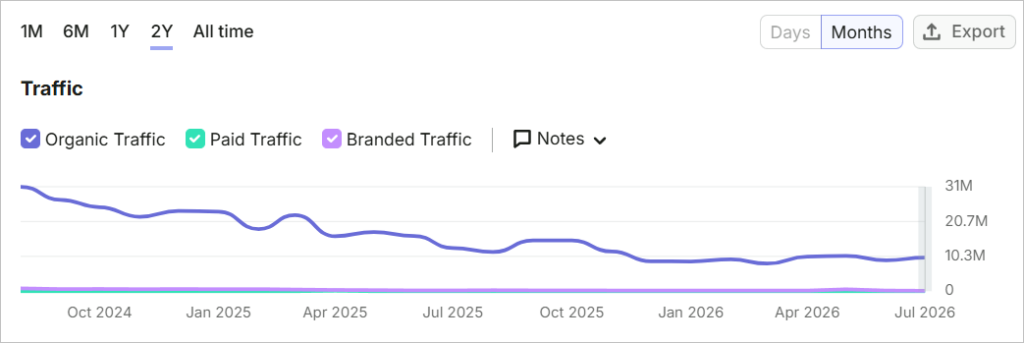
Rather than expanding the old Pulse strategy, LinkedIn appears to have started investing in pages that offer more original value.
Instead of presenting only user generated content, the company now creates an AI generated overview before showing community posts.
That approach gives both users and search engines something unique to consume.
It is important to note that this relationship is correlational. The available evidence does not prove that the traffic decline caused the redesign. However, the timing suggests the redesign may have been part of LinkedIn’s response to changing search conditions.
While Pulse declined, Top Content started growing
The strongest evidence comes from the Top Content subfolder itself.
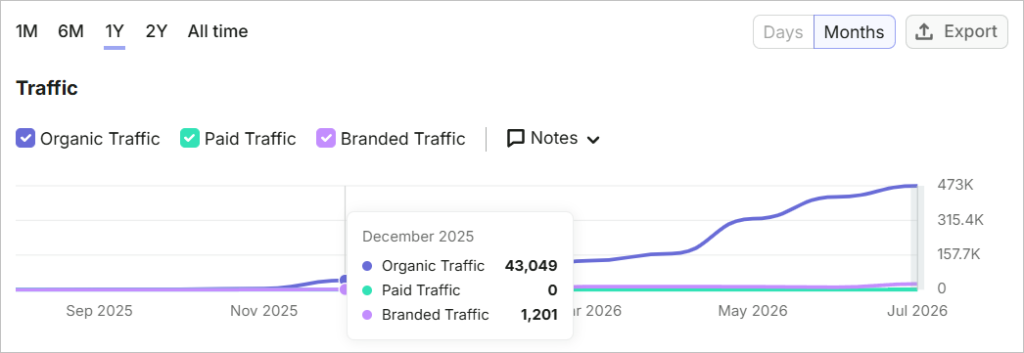
Although LinkedIn’s overall organic traffic continued falling, the /top-content/ section began gaining visibility after the redesign.
Traffic remained small compared with LinkedIn’s overall domain, but the growth curve steadily increased through 2026.
This suggests that Google’s search results were rewarding these newer pages more frequently.
Why this approach may work better
Traditional Pulse articles depended entirely on individual creators.
Anyone could publish content.
Over time, many publishers focused on ranking rather than helping readers. The platform became flooded with repetitive list articles, low quality advice, and keyword-focused content. This pattern has appeared on many open publishing platforms.
Once publishers discover that Google rewards a certain type of content, spam usually follows.
The Top Content model changes that dynamic.
Instead of ranking thousands of standalone articles, LinkedIn now controls the page creation process. Each page combines multiple community discussions. On top of that, AI creates a summary that answers the search intent.
What SEOs can learn
Community content becomes far more useful when AI helps organize and summarize it.
Large discussion threads often contain hundreds of comments, making it difficult for users to find the information they actually need. Even when valuable insights exist, they are buried deep inside long conversations.
By adding an AI summary at the top of the page, LinkedIn reduces that friction. Users can quickly understand the key ideas in seconds instead of reading through every comment. If they want more context, they can then explore the original posts and discussions below. This creates a better search experience because users get an immediate answer while still having access to the full community conversation.
In other words, AI does not replace the community. It acts as the first layer that surfaces the most important insights, while the original comments provide the supporting details and different perspectives.
This makes community-generated content much easier to consume for both users and search engines.
Final thoughts
LinkedIn’s redesign of its Top Content pages is more than a visual update.
It represents a shift in how large platforms may approach SEO in the AI era.
The company appears to be moving away from relying solely on user-generated articles and toward curated knowledge pages built from its own community discussions.
The available evidence suggests this strategy began rolling out between October and December 2025.
Since then, the Top Content section has shown steady organic growth while LinkedIn’s broader organic traffic has continued to decline.
It is still too early to conclude whether this strategy will reverse LinkedIn’s overall SEO performance.
What is clear is that LinkedIn has changed its approach.
Instead of simply indexing conversations, it is increasingly summarizing them. That may prove to be a more sustainable model for search in the years ahead.